When I think about 2010, I feel quite short on words. I've been asked, "So how was your year?" or "How does it feel to be home?" and of course, my year was life-changing and it feels really good to be back at home, surrounded by familiar faces and simple wonders that I will never again take for granted.
But I still feel that I haven't done any justice to the year I spent in South Africa. I don't know how to go about telling my story, so I've decided to share some photos, maybe an accompanying story, and piece together my year this way.
The next community leaves for South Africa's sunny shores in just a few days. I'll spend a few hours with the four of them on Saturday evening, and I feel so excited for the adventures they're about to experience, yet a part of me yearns to be stowing away and tagging along for the ride. Now that the holidays are over and I've been reunited with the people and the country I left behind one year ago, I feel as though I should be going back-- back to school, back to St. Theresa's homework time, back to karaoke on Wednesday nights at The Highlander and Durban's beachfront and rugby matches on the weekends and Robson's delicious microbrewed beer. Thinking about it all makes my heart hurt a bit.
As for the here and now, I'm frantically applying for jobs whenever I can in education, housing, and academic non-profits in New York and Philadelphia, and recently applied to a few graduate programs as alternatives, in case the whole employment thing remains out of reach. I'll find something, I know-- and for now, I'm content to enjoy the snow while reminiscing about the Durban summer.
Enjoy the photos, but I'm pretty sure that there's as much for me as they are for you. And thank you, ngiyabonga kakhulu, for keeping up with me.
P.S. I'm also back on my old blog. Though life is not as "different" as it was this time last year, I still like to think there are things worth noting.
.

Showing posts with label reflections. Show all posts
Showing posts with label reflections. Show all posts
Thursday, January 13, 2011

Monday, November 22, 2010
what it's worth.
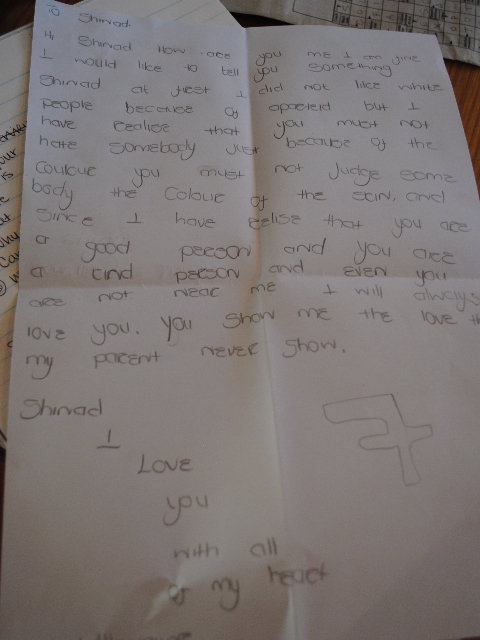
"To Shinad
Hi Shinad How are you me I am fine. I would like to tell you something. Shinad at first I did not like white people because of aparteid but I have realise that you must not hate somebody just because of the colour. You must not judge some body the colour of the skin, and since I have relise that you are a good person and you are a kind person. And even you are not near me I will always love you. You show me the love that my parent never show.
Shinad I love you with all of my heart
From: Hlengiwe"
.
Saturday, October 30, 2010
pineapples in heaven.
Mlungisi Mzobe was buried on a Saturday in October, in between the morning sunshine and afternoon storms of springtime in South Africa. He was just eighteen years old.
I only spent a few scattered hours with him here and there; the funeral was the most time Mlungisi and I ever spent together. During the strike, when Becky was visiting, we helped Mary-Kate bring a few of the healthier patients from the Respite Centre to the shopping centre for ice cream. Becky and I sat with two guys, both named Mlungisi- one older and one younger. They both insisted on large plain vanilla soft-serve but with the chilly August wind blowing in through the door of the shop, were too cold to finish. We got lids and they brought their ice creams back to put in the fridge for later. Mlungisi was happy to answer the simple questions we asked him about where he came from and his family, and when he asked about my life, he could not for the life of him understand why I would want to be a teacher in Molweni.
The next few times I saw Mlungisi, he was in bed at the Respite. I remember he had the most graceful, slender fingers that would rest on the blanket of his bed.
When he got moved to a private room, he knew the outlook wasn't good; patients didn't just get moved to private rooms for increased privacy.
I would run in to pick up Mary-Kate or Meg from work and go to say hello. Once we had to run out to Spar to pick up some Sprite for him. He never failed to request food or drink from the careworkers-- there was the time he asked for a pineapple and just kept it by his bedside. I don't think he ever ate it. Or when someone would make a run to KFC; he couldn't eat fried chicken, but he'd order something and just have it next to him on the bed. It always reminded me of a book I read as a child, where a man who couldn't afford food would satiate his hunger on the smell of dinners being prepared in the alleys behind restaurants.
A couple of weeks ago, after he'd been moved out of the private room and back into a regular bed, Mlungisi was discharged from the Respite and transferred to St. Mary's Hospital. I was sad that I wouldn't get to see him anymore, but hopeful that the transfer meant that all his hard work was paying off; that his CDC count was climbing, that his TB wasn't the dreaded MDR variety and that he was finally back in control of his own body.
He died on October 14th.
All the other people who had come to say goodbye were doing so to a body they no longer recognized. Though his smile and those long, slender fingers were the same, the sickness had sunken his eyes, shrunken his skin, and worst of all, frightened such a kind, caring young man. That's what upset me the most-- Mlungisi was terrified of dying. I think that's what kept him fighting and hanging on.
In the photo that his family placed on his beautiful coffin, I hardly recognized Mlungisi's face. I'd never seen him look so healthy. But it served as a reminder that no matter how sad I felt at Mlungisi's funeral, my grief was minor in comparison to that of his gogos and siblings, the friends he grew up with, his fellow students who came in their uniforms. School uniforms don't belong at a funeral.
Mlungisi Mzobe will never be a father, never watch another soccer match, never run around causing trouble with his friends again. And he never did eat his pineapple... but I'm pretty sure that they have pineapples in heaven.
Phumula no thula, Mlungisi.
.
I only spent a few scattered hours with him here and there; the funeral was the most time Mlungisi and I ever spent together. During the strike, when Becky was visiting, we helped Mary-Kate bring a few of the healthier patients from the Respite Centre to the shopping centre for ice cream. Becky and I sat with two guys, both named Mlungisi- one older and one younger. They both insisted on large plain vanilla soft-serve but with the chilly August wind blowing in through the door of the shop, were too cold to finish. We got lids and they brought their ice creams back to put in the fridge for later. Mlungisi was happy to answer the simple questions we asked him about where he came from and his family, and when he asked about my life, he could not for the life of him understand why I would want to be a teacher in Molweni.
The next few times I saw Mlungisi, he was in bed at the Respite. I remember he had the most graceful, slender fingers that would rest on the blanket of his bed.
When he got moved to a private room, he knew the outlook wasn't good; patients didn't just get moved to private rooms for increased privacy.
I would run in to pick up Mary-Kate or Meg from work and go to say hello. Once we had to run out to Spar to pick up some Sprite for him. He never failed to request food or drink from the careworkers-- there was the time he asked for a pineapple and just kept it by his bedside. I don't think he ever ate it. Or when someone would make a run to KFC; he couldn't eat fried chicken, but he'd order something and just have it next to him on the bed. It always reminded me of a book I read as a child, where a man who couldn't afford food would satiate his hunger on the smell of dinners being prepared in the alleys behind restaurants.
A couple of weeks ago, after he'd been moved out of the private room and back into a regular bed, Mlungisi was discharged from the Respite and transferred to St. Mary's Hospital. I was sad that I wouldn't get to see him anymore, but hopeful that the transfer meant that all his hard work was paying off; that his CDC count was climbing, that his TB wasn't the dreaded MDR variety and that he was finally back in control of his own body.
He died on October 14th.
All the other people who had come to say goodbye were doing so to a body they no longer recognized. Though his smile and those long, slender fingers were the same, the sickness had sunken his eyes, shrunken his skin, and worst of all, frightened such a kind, caring young man. That's what upset me the most-- Mlungisi was terrified of dying. I think that's what kept him fighting and hanging on.
In the photo that his family placed on his beautiful coffin, I hardly recognized Mlungisi's face. I'd never seen him look so healthy. But it served as a reminder that no matter how sad I felt at Mlungisi's funeral, my grief was minor in comparison to that of his gogos and siblings, the friends he grew up with, his fellow students who came in their uniforms. School uniforms don't belong at a funeral.
Mlungisi Mzobe will never be a father, never watch another soccer match, never run around causing trouble with his friends again. And he never did eat his pineapple... but I'm pretty sure that they have pineapples in heaven.
Phumula no thula, Mlungisi.
.
Monday, October 4, 2010
schizophrenia.

All I've been asking is to work. I came to South Africa to forge relationships with people across racial, cultural, and economic boundaries. I came to work, to be a teacher and attempt to teach vowel sounds and strengthen English speaking skills.
And with the World Cup, and strikes, and holidays, and the laziness of the government, I've been sitting at home far more often than I'd imagined, writing letters and applying for jobs.
Then school reopens, and instead of brimming with joy to be back in the saddle again, I find out that someone attempted to break into the library over holidays and spend half the morning being deafened by the sounds of Sir Sibisi and some of the Grade 6 boys (who should have been in class) busting open the locks so we could get inside our classroom. Then three-fourths of Grade 6 didn't show up for class and Bec was feeling really sick, poor thing, and the whole day was such a disaster.
And, to top it off, it's been raining since I woke up.
I am aware that this blog makes me sound like a textbook schizophrenic-- elated to be here one moment, depressed the next, and flitting from emotion to emotion day after day, minute after minute. But I might be a schizo at this point. To feel "get me outta here" mixed with "ohmygod two months left" and "i can't believe i actually have to say goodbye", with a generous splash of "hanging out with my family and friends is going to be paradise", I just feel so mixed-up and over saturated with every sort of feeling that I'm completely exhausted.
I'm going to bed. Goodnight.
.
Sunday, September 12, 2010
status quo.
I've been thinking a lot about how important the idea of status is to the Zulu people I've encountered. This covers everything, from the latest technological possessions to cars to even which students have the sharpest pencils in the classroom.
One of the hardest things that I've realized about teaching is how easy it can be to pick favourites. This isn't even restricted to St. Leo's-- at the boys' home, too, there are certain kids that I get along with and who feel more comfortable around me than others. There's Sanele, in Grade 4, who cannot sit still and has been known to steal food from kindergartners at break time. But he calls me "Mrs. Sinead" and it makes my heart melt. Then there's Bheki at St. Theresa's; he may drool when he gets overexcited and eat chicken liver pate straight from the container with a spoon, but I just love that Kanye West face of his.
But playing favourites doesn't even mean that kids feel left out if I feel the need to pay special attention to one or the other. It's all about having things. Children here are more concerned about having the sharpest pencil in the class, or being able to buy unhealthy snacks at breaktime instead of eating the prepared samp, finding an old Bluetooth on the ground and wearing it around the schoolyard, with more pride than the most successful investor on Wall Street.
And this phenomenon isn't restricted to children either. Mary-Kate told me last week about a Zulu man who had asked the nun sponsoring him through nursing school if he could get a car. She agreed to help him, but then made a very good point: this guy didn't have a drivers' license. He seemed completely unperturbed by this. He just wanted a car.
It's easy to say that this all comes from people who don't have much taking pride in what they can get their hands on, but when a hefty paycheck goes towards purchasing the latest flat-screen TV in a rundown tinroof house with no running water, I feel very confused at the logic.
It's also easy to expand these scenarios and take a look at the government of this country (and elsewhere). Government officials spend big bucks on flashy cars, expensive suits, and family vacations, while in the same city, someone even related to them might be suffering from treatbale TB with no money for medicine.
I never mean to express political criticism, but I can't help noticing how even the microcosm of St. Leo's is a small-scale model for how things operate on a national level in South Africa.
Mum has been faithfully clipping articles from the Financial Times that might pique my interest, and when a package arrived the other day with two books from my sister (who is studying abroad in Paris at the moment; read her blog here), it also had a giant stack of articles with it.
One of them, written back in July, is an interview with six different South Africans post-World Cup. It is a really interesting piece, with many points I've been reflecting on, but in a much more succinct and articulate manner. You can find the article here, and I'd highly recommend taking the time to read it.
Oh, and school is open again, much to my relief. More on that later...
.
One of the hardest things that I've realized about teaching is how easy it can be to pick favourites. This isn't even restricted to St. Leo's-- at the boys' home, too, there are certain kids that I get along with and who feel more comfortable around me than others. There's Sanele, in Grade 4, who cannot sit still and has been known to steal food from kindergartners at break time. But he calls me "Mrs. Sinead" and it makes my heart melt. Then there's Bheki at St. Theresa's; he may drool when he gets overexcited and eat chicken liver pate straight from the container with a spoon, but I just love that Kanye West face of his.
But playing favourites doesn't even mean that kids feel left out if I feel the need to pay special attention to one or the other. It's all about having things. Children here are more concerned about having the sharpest pencil in the class, or being able to buy unhealthy snacks at breaktime instead of eating the prepared samp, finding an old Bluetooth on the ground and wearing it around the schoolyard, with more pride than the most successful investor on Wall Street.
And this phenomenon isn't restricted to children either. Mary-Kate told me last week about a Zulu man who had asked the nun sponsoring him through nursing school if he could get a car. She agreed to help him, but then made a very good point: this guy didn't have a drivers' license. He seemed completely unperturbed by this. He just wanted a car.
It's easy to say that this all comes from people who don't have much taking pride in what they can get their hands on, but when a hefty paycheck goes towards purchasing the latest flat-screen TV in a rundown tinroof house with no running water, I feel very confused at the logic.
It's also easy to expand these scenarios and take a look at the government of this country (and elsewhere). Government officials spend big bucks on flashy cars, expensive suits, and family vacations, while in the same city, someone even related to them might be suffering from treatbale TB with no money for medicine.
I never mean to express political criticism, but I can't help noticing how even the microcosm of St. Leo's is a small-scale model for how things operate on a national level in South Africa.
Mum has been faithfully clipping articles from the Financial Times that might pique my interest, and when a package arrived the other day with two books from my sister (who is studying abroad in Paris at the moment; read her blog here), it also had a giant stack of articles with it.
One of them, written back in July, is an interview with six different South Africans post-World Cup. It is a really interesting piece, with many points I've been reflecting on, but in a much more succinct and articulate manner. You can find the article here, and I'd highly recommend taking the time to read it.
Oh, and school is open again, much to my relief. More on that later...
.
Tuesday, August 24, 2010
struck.

The beach in Durban where the FIFA Fan Fest was set up just six weeks ago.
It's been eleven days since I've worked at St. Leo's. In that time, which started out as a Friday I'd wanted to take off to spend time with Becky in Cape Town, all public servants in South Africa are on strike. Government schools (and some private ones) are closed, as are government hospitals and most clinics. The sick can't get treatment, and more importantly, those with HIV/AIDS and tuberculosis who depend on regularly scheduled medicine have no access to their prescriptions. Children enrolled in government schools sit at home or at a relative's house, bored out of their minds, because their families cannot afford to send them to private school in the first place. Sadly, many of these kids depend on their biggest meal of the day coming from the school kitchen, and they will go hungry unless they find aid elsewhere.
Themba is in hospital with a stomach ulcer and other complications, and when Becca and I went to see her today, she told us that she'd had a phone call from Smangele Khumalo, a learner in Grade 5. All Smangele told Themba was that she was very hungry; Themba did her best to convince her that the strike would end soon, then hung up the phone and cried for the rest of the night. We also spoke about how fortunate Themba is to be able to afford care in a private hospital-- otherwise her ulcer would go untreated and the fibroids they found would have gone unnoticed.
I've been talking a lot with people, both in South Africa and at home, about everything going on, and the general consensus is that the issues causing this strike are so deeply rooted in South Africa's turbulent and segregated history that it's really hard to be hopeful about the outcome. There has been very little said on the government's part, and the president is no better; Jacob Zuma's latest announcement was that he had attended the highly anticipated Springboks/All Blacks rugby match in Soweto last Saturday with his cabinet members. For people who suffered through centuries of being powerless to now have as much influence as they can get is a recipe for disaster (see: Julius Malema, and also the ANC's recent announcement to enact a media tribunal on all journalistic coverage of government policies and activity).
And the poor of South Africa cannot win. Those who wish for higher salaries are using the only advantage they have-- their ability to work-- to change the minds of those they elected to power in the first place. And those affected by the strike are equally annoyed at the government. The ANC was elected to power in 2009 by the very people it is now turning its back on. The blame game turns into an endless cat-and-mouse chase with lots of pointed fingers and not much progress.
But no matter who is to blame, the fact of the matter is that people are starving, children cannot attend school, and the sick will die without access to proper treatment and medication. The results from matriculation exams (the equivalent of the Leaving Cert, GCSE, or other final exams to graduate high school) in this country were already abysmal, and now with exams so close, there is a very good chance that South Africa's meager 15% pass rate will dip even lower.
And all this in a country that just six short weeks ago played host to one of the most widely-viewed sporting competitions in the world. In Durban alone, trillions of rand were poured into the construction of a beautiful airport and magnificent stadium, as well as the complete and much-needed renovation of the Golden Mile along the beach front downtown. People were hired as "beach guards" to look after worried tourists' buckets and spades while they took a dip in the balmy Indian Ocean. Peace Officers strolled along the road with municipal police to keep people's minds at ease. In the fan parks, people gathered in the warm Durban winter to watch soccer together, regardless of nationality, race, economic status, or age.
But now it's over, and garbage collects on the beach while police officers busy themselves with forcing the homeless off benches along the promenade. Now that the strike is in full force, they've been dispatched to places like Addington Hospital in the city, where they were forced to fire rubber bullets into a crowd of protesters. Parents of some of the learners at St. Leo and elsewhere have lost their jobs, and the scar that runs so deeply in this achingly beautiful country cannot be covered up any longer.
In one of Durban's newspapers called The Mercury, a piece by someone named Danie Joubert was published in yesterday's Opinions section. Though the column was striking in many ways, this passage in particular stood out to me:
It is obvious we have our social investment priorities wrong. We can convince ourselves to spend hundreds of billions on sports stadiums and infrastructure that had a one-month emotional impact and a limited future utilisation return value, but we cannot convince ourselves to invest the seed capital in human capital formation that assures future harmony and prosperity for a nation.
I can only hope that some sort of agreement can be reached, and soon. With the lives and well-being of the poor, especially children and the sick, at stake, a resolution needs to happen before things get any worse.
.
Monday, July 12, 2010
the view from here: the 2010 world cup in photos
You've seen the matches on TV, heard "Waka Waka" and "Wave Your Flag" more times than you can count on the radio, and I've shared articles with you about South Africa's struggle and success in hosting this year's FIFA World Cup... so what now?
I thought I'd do something a bit more exciting, and give you a peek at what June 11th to July 11th looked like from where I stand. I left the United States on January 11th, making the opening day of the World Cup a five-month marker, and the closing ceremony our six-month anniversary as AVs here in South Africa. And what a month it was.

We decorated the St. Leo's library (our classroom) with projects about the World Cup...

... and went a little crazy as the term came to an end.

I got to judge a World Cup art contest-- no easy task, I promise you...

... and also banned vuvuzelas from the classroom.

We had friends in crazy flag trousers (and vuvuzelas)...

... and strangers in crazier flag UNITARDS (and more vuvuzelas)!

Then the world became that much smaller when we met a fellow Villanova alum (Class of '97 anyone?) at the fan park on the Durban beachfront.

We refereed intense soccer matches during our holiday programme at St. Leo's, complete with future Bafana Bafana star athletes...

...and taught Kwazi, Kwanele, and our 45 other campers how to make yarn bracelets in their favourite team colours.

We watched Bafana Bafana beat France with some of the boys from St. Theresa's, in one of the stickiest, most sugar-laced afternoons yet...

... and decked ourselves out in red, white, and blue to hit the beach...

... twice.

And last night, we wrapped up the festivities with some of our closest friends, feeling sad and relieved and proud and very, very exhausted, all at once.

And now we have fresh crayons, a return to routine, and five more months to make the most of our time here in South Africa.
Saturday, July 10, 2010
running to stand still.
This volunteer year is a test of endurance in many ways. There are the tough situations at work, when undernourished children don't have enough to eat at break time or suffer from sores on their little bodies, betraying the secret of their illness. There's the challenge of living with three like-minded, strong-willed women who don't get enough sleep at night. There's the 6000+ miles between my four favorite people (and two cats) and me, and though God gave us Skype and GChat, there's no e-equivalent for the comforts of home.
And, as if these things weren't testing my endurance enough, I've taken to running. My shin-splinting, asthmatic, tired body is subjected to a couple of miles most evenings after work, before the sun sets.
I was never much of a runner; at best I could sprint the 200 meter dash, and when I got to high school, a track team didn't even exist. The prospect of running 5 kilometers as part of the varsity cross-country team was daunting, but I decided to join and working on my stamina was a project I tried for years to accomplish. In college, I tried to keep up with running but late nights in the library coupled with seasonal illness and a side of college nightlife made regular runs hard to come by.
Now, though I find myself more physically exhausted by work (and occasionally play, to be completely honest) than I've ever been before, I make a special effort to drag myself around "the loop", a mile-and-a-half stretch of quiet suburbia across the road from our house. I've taken great comfort in spending thirty minutes with just my iPod and my thoughts, and to my surprise, the fixation on exhaustion and breathing trouble and sore muscles I'd struggled with in the past has now melted away.
Today, on a particularly beautiful Friday afternoon, a U2 song filled my headphones, called "Running to Stand Still". It's an old one, from The Joshua Tree, but I was struck by the lyrics as I cooled down and stood looking over the valley.
And so she woke up
Woke up from where she was lying still
Said I gotta do something about where we're going.
And there it was. My mind is no longer thinking about exhaustion, or muscle pain-- it's simply too preoccupied with other thoughts to focus on the physical aspect of exercise. I enjoy running so much here because I've finally got things more important to think about than myself, and I'm really glad to reach that realization. One of my goals of my time here was to focus on things other than personal issues, and it seems that my mind's inevitably begun to shift that way.
The service I do here is time-consuming and draining; it often requires a complete commitment of mind and body to get through the days. And so, when it comes time to reflect on my life here in South Africa, the best way I've found to do so is by physical activity-- it's when I'm most active that I find a quiet moment or two. It really is running to stand still.
And, as if these things weren't testing my endurance enough, I've taken to running. My shin-splinting, asthmatic, tired body is subjected to a couple of miles most evenings after work, before the sun sets.
I was never much of a runner; at best I could sprint the 200 meter dash, and when I got to high school, a track team didn't even exist. The prospect of running 5 kilometers as part of the varsity cross-country team was daunting, but I decided to join and working on my stamina was a project I tried for years to accomplish. In college, I tried to keep up with running but late nights in the library coupled with seasonal illness and a side of college nightlife made regular runs hard to come by.
Now, though I find myself more physically exhausted by work (and occasionally play, to be completely honest) than I've ever been before, I make a special effort to drag myself around "the loop", a mile-and-a-half stretch of quiet suburbia across the road from our house. I've taken great comfort in spending thirty minutes with just my iPod and my thoughts, and to my surprise, the fixation on exhaustion and breathing trouble and sore muscles I'd struggled with in the past has now melted away.
Today, on a particularly beautiful Friday afternoon, a U2 song filled my headphones, called "Running to Stand Still". It's an old one, from The Joshua Tree, but I was struck by the lyrics as I cooled down and stood looking over the valley.
And so she woke up
Woke up from where she was lying still
Said I gotta do something about where we're going.
And there it was. My mind is no longer thinking about exhaustion, or muscle pain-- it's simply too preoccupied with other thoughts to focus on the physical aspect of exercise. I enjoy running so much here because I've finally got things more important to think about than myself, and I'm really glad to reach that realization. One of my goals of my time here was to focus on things other than personal issues, and it seems that my mind's inevitably begun to shift that way.
The service I do here is time-consuming and draining; it often requires a complete commitment of mind and body to get through the days. And so, when it comes time to reflect on my life here in South Africa, the best way I've found to do so is by physical activity-- it's when I'm most active that I find a quiet moment or two. It really is running to stand still.
Monday, July 5, 2010
the spectrum.
When I signed up to be an Augustinian Volunteer, and even during my time as an undergraduate at Villanova, I became accustomed to "reflection" pretty quickly. Whether it was at AV Orientation, during a service break trip during college, or even in some of my classes, the idea of "reflecting" on my experience was something the Augustinian mindset got me very used to. So when I came to South Africa as a volunteer, and an Augustinian Volunteer at that, I was fully prepared to "reflect". I didn't know it would be so hard, and I certainly had no idea that it wouldn't be just frustration, or guilt, or sadness, or joy at one time-- I didn't know that my head and heart would take on the gamut of emotions every single day.
After a week and a half of a really successful time with the St. Leo's kids and our summer programme, we had to end things early. There had been kids showing up that we didn't know-- the word was out that we had soccer balls and sandwiches and so these other children from Molweni began to outnumber our own kids. Themba and Ayanda, two coworkers from St. Leo's, were both a great help to us during the camp, but last Tuesday, Themba pulled Mary-Kate and I aside and told us that she didn't think continuing the camp was safe, for us or for the children. She pointed to one of the teenagers wearing a Bafana Bafana jersey and playing netball in the grounds and said, "That girl's family lives here in Molweni... and I know for a fact that her father and brother are professional thieves. Who's to say that they didn't send her here to get information for them?" While it's hard to believe that situations like that arise, they do, and putting ourselves in the middle of them compromises too much. We also heard rumors that the older kids who showed up to play soccer were stealing sandwiches from the younger St. Leo's students, which made me more upset than anything. It's hard enough to dole out food to hungry kids, but dealing with these older kids taking advantage of our learners was really hard to hear.
We went ahead with the movie screening we'd planned for Wednesday-- nothing beats hearing Zulu kids singing along to High School Musical like any good pre-teens would-- and then said goodbye to everybody until we see them again next week, when school restarts. I'll be really relieved to get back to seeing them all every day again.
With the camp ending early, I had to find some other way to occupy my days, so I decided to work a day at the Hillcrest AIDS Respite Centre this past Friday. Though I'm not cut out for that kind of work on a daily basis, I often feel like I should put more pressure on myself to be challenged-- and that's how I found myself standing over one of the patients, giving her a bedbath. I'd never done something like that before, and it was hard. Really hard. She was in a lot of pain, and even raising her arm so I could wash underneath was a huge effort, but I tried to make lighthearted conversation, even telling her that her legs were long enough that she could be a model. I realize now that the comments were just to keep myself distracted.
I spent the remainder of the day on Friday holding Bianca, a one-year-old who had just been admitted, with her mother, the day before. She's HIV positive, has TB, and looks more like a 4-month-old than one whole year. Although she's sick, she's happy just to have attention and be held like any baby, and I really enjoyed spending time with her. She has the most beautiful eyes-- and is so curious! All I can do is spend time with her and hope that she gets better soon.
Then the weekend came, and with it, more World Cup festivities. These past few weeks have flown by (it's already July?!) but all this waving of flags and blowing of vuvuzelas has gotten really tiring. I'm happy with how South Africa has handled all this commotion so far, but I'm really nervous for the aftermath. That being said, we had a nice weekend, spent some time at the fan park and down around Durban-- even enjoying a Greek lunch on Saturday in the gorgeous winter sun. After a long afternoon nap in the sunshine yesterday, we invited a few friends over for a small 4th of July celebration... and we even conquered lighting the charcoal barbecue all on our own! And, even though the USA is out of the World Cup, I had another excuse to don my soccer scarf last night-- once the sun goes down around 5 or so, it gets really chilly up here!
And now it's Monday, and already today I woke up exhausted after another restless night of sleep. I laughed with the kids at 1000 Hills, as we played games and sang "Head, Shoulders, Knees, and Toes". I vented frustration to Becca after another failed attempt to pick up a pension for Gogo Gloria, who lives at the bottom of a steep hill in kwaNyuswa and can't walk thanks to infected skin grafts, the result of terrible snake bites on her legs. I heard from Mary-Kate that the patient I bathed on Friday died over the weekend, and consequently went for a run to clear my head. I sat on the hill and cried. I met an Irish woman named Mary who is on a silent retreat at the center next door. I caught up with my family back at home via videochat, and laughed at their jokes..... all in one day.
My work here is tiring, and challenging, and stressful, but it's the emotional work that is most grueling. My roommates and I often joke that our friendships have been put on overdrive-- we have one year to become roommates, community members, and hopefully, friends. But every day here is overdrive. Every single day, my emotions go from one to the other and back again, and before I know it, the day is over and I lie in bed, completely overwhelmed at the thought of my life here. And that is why blogging is hard, writing letters is hard, talking to people on the phone is hard-- the process of reflecting on my daily life seems sometimes to be a task too gigantic to undertake sometimes.
But I'm trying. Thankfully, Becca, Meg, and Mary-Kate are incredibly understanding, patient, loving people who deal with me on a daily basis... and vice versa. We've made some really good friends with South Africans as well, both our age and older. The Augustinians we live with are fantastic, and even my students at St. Leo's seem to have a sixth sense about my emotions.
So even though it's hard to be here, and be present, and process everything all at the same time, I'm forced to be held accountable for how I feel, and that's a challenge I really value as the sun sets at the end of the day.
After a week and a half of a really successful time with the St. Leo's kids and our summer programme, we had to end things early. There had been kids showing up that we didn't know-- the word was out that we had soccer balls and sandwiches and so these other children from Molweni began to outnumber our own kids. Themba and Ayanda, two coworkers from St. Leo's, were both a great help to us during the camp, but last Tuesday, Themba pulled Mary-Kate and I aside and told us that she didn't think continuing the camp was safe, for us or for the children. She pointed to one of the teenagers wearing a Bafana Bafana jersey and playing netball in the grounds and said, "That girl's family lives here in Molweni... and I know for a fact that her father and brother are professional thieves. Who's to say that they didn't send her here to get information for them?" While it's hard to believe that situations like that arise, they do, and putting ourselves in the middle of them compromises too much. We also heard rumors that the older kids who showed up to play soccer were stealing sandwiches from the younger St. Leo's students, which made me more upset than anything. It's hard enough to dole out food to hungry kids, but dealing with these older kids taking advantage of our learners was really hard to hear.
We went ahead with the movie screening we'd planned for Wednesday-- nothing beats hearing Zulu kids singing along to High School Musical like any good pre-teens would-- and then said goodbye to everybody until we see them again next week, when school restarts. I'll be really relieved to get back to seeing them all every day again.
With the camp ending early, I had to find some other way to occupy my days, so I decided to work a day at the Hillcrest AIDS Respite Centre this past Friday. Though I'm not cut out for that kind of work on a daily basis, I often feel like I should put more pressure on myself to be challenged-- and that's how I found myself standing over one of the patients, giving her a bedbath. I'd never done something like that before, and it was hard. Really hard. She was in a lot of pain, and even raising her arm so I could wash underneath was a huge effort, but I tried to make lighthearted conversation, even telling her that her legs were long enough that she could be a model. I realize now that the comments were just to keep myself distracted.
I spent the remainder of the day on Friday holding Bianca, a one-year-old who had just been admitted, with her mother, the day before. She's HIV positive, has TB, and looks more like a 4-month-old than one whole year. Although she's sick, she's happy just to have attention and be held like any baby, and I really enjoyed spending time with her. She has the most beautiful eyes-- and is so curious! All I can do is spend time with her and hope that she gets better soon.
Then the weekend came, and with it, more World Cup festivities. These past few weeks have flown by (it's already July?!) but all this waving of flags and blowing of vuvuzelas has gotten really tiring. I'm happy with how South Africa has handled all this commotion so far, but I'm really nervous for the aftermath. That being said, we had a nice weekend, spent some time at the fan park and down around Durban-- even enjoying a Greek lunch on Saturday in the gorgeous winter sun. After a long afternoon nap in the sunshine yesterday, we invited a few friends over for a small 4th of July celebration... and we even conquered lighting the charcoal barbecue all on our own! And, even though the USA is out of the World Cup, I had another excuse to don my soccer scarf last night-- once the sun goes down around 5 or so, it gets really chilly up here!
And now it's Monday, and already today I woke up exhausted after another restless night of sleep. I laughed with the kids at 1000 Hills, as we played games and sang "Head, Shoulders, Knees, and Toes". I vented frustration to Becca after another failed attempt to pick up a pension for Gogo Gloria, who lives at the bottom of a steep hill in kwaNyuswa and can't walk thanks to infected skin grafts, the result of terrible snake bites on her legs. I heard from Mary-Kate that the patient I bathed on Friday died over the weekend, and consequently went for a run to clear my head. I sat on the hill and cried. I met an Irish woman named Mary who is on a silent retreat at the center next door. I caught up with my family back at home via videochat, and laughed at their jokes..... all in one day.
My work here is tiring, and challenging, and stressful, but it's the emotional work that is most grueling. My roommates and I often joke that our friendships have been put on overdrive-- we have one year to become roommates, community members, and hopefully, friends. But every day here is overdrive. Every single day, my emotions go from one to the other and back again, and before I know it, the day is over and I lie in bed, completely overwhelmed at the thought of my life here. And that is why blogging is hard, writing letters is hard, talking to people on the phone is hard-- the process of reflecting on my daily life seems sometimes to be a task too gigantic to undertake sometimes.
But I'm trying. Thankfully, Becca, Meg, and Mary-Kate are incredibly understanding, patient, loving people who deal with me on a daily basis... and vice versa. We've made some really good friends with South Africans as well, both our age and older. The Augustinians we live with are fantastic, and even my students at St. Leo's seem to have a sixth sense about my emotions.
So even though it's hard to be here, and be present, and process everything all at the same time, I'm forced to be held accountable for how I feel, and that's a challenge I really value as the sun sets at the end of the day.
Wednesday, May 19, 2010
back to 'ubuntu'.
You know you live in South Africa when you go for your Saturday morning run and see what you are convinced is yet another pesky monkey... but upon closer inspection, it turns out to just be a cat.
And then you go two days without running water because "the reservoir is empty" and have to fill up buckets, jugs, anything you can find-- just to be able to wash dishes and brush your teeth-- when the eThekwini Municipality water truck trundles down the street. You learn why Zulu women carry their heavy loads on their heads; who knew it would be much easier to walk back up Warwickshire Crescent once you learn to maintain balance with a couple of kilos on your head? And then, after dutifully accepting that you'll have to suffer one more day before trekking to the parish at Kloof for a shower, the water spurts out of the taps and for the next couple of days, every time you turn on the tap you'll be thankful for the gift of running water.
Amidst homesickness, frustration, even fatigue, it's hard to forget where I am. Constantly being reminded of my surroundings has helped to bring me back to the reasons I decided to sign up for this crazy experience.
I stand at morning prayer with my students at St. Leo's, basking in the smiles on their faces, humbled by the devout way they close their eyes and fold their hands while they pray. I watch the boys of Cottage 4 at St. Theresa's Home for Boys struggle through the choreography during a dance class, and can't help loving them even when they won't sit down to do homework. They're getting ready to perform at Moses Mabhida stadium here in Durban during the World Cup, and the prospect of seeing them on TV might be the thing I look forward to most during this FIFA fever craziness.
I share frustration, sadness, and laughter with the three other girls in my community-- even sometimes sharing silence too-- and our level of comfort and closeness with one another is such a good thing to have. We may spend every waking moment together, but we can't be completely tired of each other yet, and we're not, if our excitement about a weekend away together is anything to go by!
It's not easy to be a volunteer, and I have to admit that May has been the toughest month personally so far, but with the midway point in sight, I'm trying really hard to keep in mind the fleeting nature of time. Before I have a chance to absorb all my experiences and feelings during my time here, that time will have passed and I'll be back in the US, heartbroken to have left my year here in the past.
And so, I'm repositioning myself and getting back to where I was before-- excited, motivated, and feeling very lucky to be able to nurture the friendships and relationships that South Africa's ubuntu has given me.
I am, because we are.
And then you go two days without running water because "the reservoir is empty" and have to fill up buckets, jugs, anything you can find-- just to be able to wash dishes and brush your teeth-- when the eThekwini Municipality water truck trundles down the street. You learn why Zulu women carry their heavy loads on their heads; who knew it would be much easier to walk back up Warwickshire Crescent once you learn to maintain balance with a couple of kilos on your head? And then, after dutifully accepting that you'll have to suffer one more day before trekking to the parish at Kloof for a shower, the water spurts out of the taps and for the next couple of days, every time you turn on the tap you'll be thankful for the gift of running water.
Amidst homesickness, frustration, even fatigue, it's hard to forget where I am. Constantly being reminded of my surroundings has helped to bring me back to the reasons I decided to sign up for this crazy experience.
I stand at morning prayer with my students at St. Leo's, basking in the smiles on their faces, humbled by the devout way they close their eyes and fold their hands while they pray. I watch the boys of Cottage 4 at St. Theresa's Home for Boys struggle through the choreography during a dance class, and can't help loving them even when they won't sit down to do homework. They're getting ready to perform at Moses Mabhida stadium here in Durban during the World Cup, and the prospect of seeing them on TV might be the thing I look forward to most during this FIFA fever craziness.
I share frustration, sadness, and laughter with the three other girls in my community-- even sometimes sharing silence too-- and our level of comfort and closeness with one another is such a good thing to have. We may spend every waking moment together, but we can't be completely tired of each other yet, and we're not, if our excitement about a weekend away together is anything to go by!
It's not easy to be a volunteer, and I have to admit that May has been the toughest month personally so far, but with the midway point in sight, I'm trying really hard to keep in mind the fleeting nature of time. Before I have a chance to absorb all my experiences and feelings during my time here, that time will have passed and I'll be back in the US, heartbroken to have left my year here in the past.
And so, I'm repositioning myself and getting back to where I was before-- excited, motivated, and feeling very lucky to be able to nurture the friendships and relationships that South Africa's ubuntu has given me.
I am, because we are.
"A person with Ubuntu is open and available to others, affirming of others, does not feel threatened that others are able and good, for he or she has a proper self-assurance that comes from knowing that he or she belongs in a greater whole and is diminished when others are humiliated or diminished, when others are tortured or oppressed."
- Archbishop Desmond Tutu
Monday, May 10, 2010
the god of small things.
Sometimes, it's in the smallest ways that you realize someone is looking out for you after all.

Found by Becca, taken while camping in Scottsburgh this weekend.
Tuesday, April 27, 2010
the land of the free?
Today is Freedom Day. How ironic is that.
We woke up at the normal time, all set to spend the day at 1000 Hills Community Helpers, where they host a baby clinic on Tuesdays. St. Leo's is closed (yet again) for the public holiday, so I'm not starting my week there until tomorrow.
Just as we were about to pile into the car, we got two phone calls-- the first from Meg, who was being sent home from the Respite Center to have a day off for the holiday, and one from Karen, telling us that 1000 Hills was also closed for Freedom Day today.
So there we were, four volunteers who'd cried off early from a party last night because we had to work today; "Volunteering never takes a holiday!" we'd said as we excused ourselves. And we had nowhere to work.
I decided there was a good opportunity to get my missing invoice from my toe procedure back in early March and then I'd finally be able to send off my insurance claim, so with eager roommates in tow, off I drove to Pinetown, where the process was shockingly painless. With form in hand two minutes later, and it now being only 8:17 am, Mary-Kate suggested we drive to Wyebank to visit Sbu, an 11-year-old who had been released from the Respite Center a couple of weeks ago.
Sbu was admitted for TB and thankfully tested negative for HIV, even though he lives in a child-headed household because his mother died of AIDS. He lives with his siblings and young cousins in a one-room shack managed by his 16-year-old cousin, who herself has a baby boy just 10 months old.
They were pleased to see us, I think, though the presence of an umlungu, or white person, always comes as a surprise in the valley. We had brought them a cake to share that the priests had given us, so we left that in the one room they call home and headed out to the yard to play a very pitiful game of soccer, though Sbu showed some pretty impressive moves when he wasn't coughing.
We played for twenty minutes or so, then got ready to leave. As we said our goodbyes, Sbu and his older sister Pamela approached us. Pamela goes to an Indian school up on the hill with a very good reputation, and her English is excellent. She drew close to Mary-Kate and then said, "My cousin (the 16-year-old head of the house) has asked me to see if you can get us some bread. For breakfast."
There we were, three people trying to say our goodbyes, and then suddenly, we're hit with the question. Several other questions began to run through our minds: If we buy them bread, are they going to expect us to provide bread every time we visit? What if we can't visit sometimes? What about the food parcels they're supposed to be receiving from the Respite Center and the Islamic Center up the road? And then, the hardest question of all... How are we, in our right minds, supposed to walk away from a household run by a mere child feeling like we did absolutely nothing to rectify the situation?
My image of poverty has shifted a lot because of things I've seen here in South Africa. The Sinead on a Villanova mission trip would have demanded that we get some bread immediately. But unfortunately, though those seven children would have eaten bread instead of cake for breakfast, that would have just been today. What about tomorrow, or the day after that?
The question of sustainable aid in situations like Sbu's takes center stage now. Their poverty is so much more than just no bread for breakfast. And I really don't know what hell I'm supposed to do about it.
As we drove home in silence, the happy buzz from an unexpected day off had long since evaporated into the humid air. Back in Hillcrest, people who had more than bread for breakfast yesterday, today, and tomorrow, donned bright white shorts and t-shirts and played a rousing round of tennis on their day off.
After all, that is what Freedom Day celebrates after all...... isn't it?
We woke up at the normal time, all set to spend the day at 1000 Hills Community Helpers, where they host a baby clinic on Tuesdays. St. Leo's is closed (yet again) for the public holiday, so I'm not starting my week there until tomorrow.
Just as we were about to pile into the car, we got two phone calls-- the first from Meg, who was being sent home from the Respite Center to have a day off for the holiday, and one from Karen, telling us that 1000 Hills was also closed for Freedom Day today.
So there we were, four volunteers who'd cried off early from a party last night because we had to work today; "Volunteering never takes a holiday!" we'd said as we excused ourselves. And we had nowhere to work.
I decided there was a good opportunity to get my missing invoice from my toe procedure back in early March and then I'd finally be able to send off my insurance claim, so with eager roommates in tow, off I drove to Pinetown, where the process was shockingly painless. With form in hand two minutes later, and it now being only 8:17 am, Mary-Kate suggested we drive to Wyebank to visit Sbu, an 11-year-old who had been released from the Respite Center a couple of weeks ago.
Sbu was admitted for TB and thankfully tested negative for HIV, even though he lives in a child-headed household because his mother died of AIDS. He lives with his siblings and young cousins in a one-room shack managed by his 16-year-old cousin, who herself has a baby boy just 10 months old.
They were pleased to see us, I think, though the presence of an umlungu, or white person, always comes as a surprise in the valley. We had brought them a cake to share that the priests had given us, so we left that in the one room they call home and headed out to the yard to play a very pitiful game of soccer, though Sbu showed some pretty impressive moves when he wasn't coughing.
We played for twenty minutes or so, then got ready to leave. As we said our goodbyes, Sbu and his older sister Pamela approached us. Pamela goes to an Indian school up on the hill with a very good reputation, and her English is excellent. She drew close to Mary-Kate and then said, "My cousin (the 16-year-old head of the house) has asked me to see if you can get us some bread. For breakfast."
There we were, three people trying to say our goodbyes, and then suddenly, we're hit with the question. Several other questions began to run through our minds: If we buy them bread, are they going to expect us to provide bread every time we visit? What if we can't visit sometimes? What about the food parcels they're supposed to be receiving from the Respite Center and the Islamic Center up the road? And then, the hardest question of all... How are we, in our right minds, supposed to walk away from a household run by a mere child feeling like we did absolutely nothing to rectify the situation?
My image of poverty has shifted a lot because of things I've seen here in South Africa. The Sinead on a Villanova mission trip would have demanded that we get some bread immediately. But unfortunately, though those seven children would have eaten bread instead of cake for breakfast, that would have just been today. What about tomorrow, or the day after that?
The question of sustainable aid in situations like Sbu's takes center stage now. Their poverty is so much more than just no bread for breakfast. And I really don't know what hell I'm supposed to do about it.
As we drove home in silence, the happy buzz from an unexpected day off had long since evaporated into the humid air. Back in Hillcrest, people who had more than bread for breakfast yesterday, today, and tomorrow, donned bright white shorts and t-shirts and played a rousing round of tennis on their day off.
After all, that is what Freedom Day celebrates after all...... isn't it?
Sunday, April 4, 2010
learning to pray.
This blog entry was written for the Augustinian Volunteers' website, which you can find here. I wrote about how my spirituality has grown so far during my year here in South Africa.
It’s another Tuesday at St. Leo’s Primary, and I’m seriously dragging. The photocopier is out of toner again, which means the vocabulary test that we’d planned for Grade 5 has to be a bit more off the cuff than I’d anticipated—but that’s the nature of teaching in this school. This is a place where almost seven hundred learners have been admitted to the school, despite lack of space and individual attention; a place where pencils are in such short supply that they have to be labelled with names to keep them from going missing; a place where teachers engaging their students in the classroom is the exception, and not the rule.
But St. Leo’s is also a place where the library is one of the most valued spots in the school; where the enrollment is so high that the administration can’t keep up, just because parents want their children to learn English with Americans; a place where the sound of young voices singing can make even the most miserable Monday mornings worth it. In a country where the population has big dreams and very little follow-through, the children at St. Leo’s are an example of the hope I’ve come to look for with each day that passes here in South Africa
Break at St. Leo’s comes early; at ten o’clock in the morning, I’m not hungry and not ready to interrupt the day just yet. On this particular Tuesday, the four classes that follow break are even more of a struggle than the two I had this morning. We attempt to review some lessons from the previous weeks after the test is finished and graded, but the learners are lethargic and I’m losing my patience. I can only repeat myself so many times—a mystery is “a puzzle without an answer”, and “a chance to do something” is an opportunity, not often. And then, just when I’m about to resort to reading them a story instead, the bells from the church next door ring to signal midday, and the sixteen Grade 5 students in front of me stand up, fold their hands, close their eyes, and bow their heads. They begin to pray.
Yethi Maria, ogcwele igrasiya, iNkosi inawe, ubusisiwe wena esifazaneni, ibusisiwe nenzalo yesisu sakho uJesu. Maria ocwebileyo, Nina kaNkulunkulu, mawusikhulekele thina zoni, manje nasesikhathini sokufa kewthu. Amen.
As the words rise to Mary who hears and understands, whether in English or in Zulu, I close my eyes and lean against the bookshelf near my desk, reflecting on the day so far and silently asking God to help me through the rest. I open my eyes again and look around the room, at the boys and girls in front of me, praying fervently in the midst of the schoolday. My heart is filled with so much love.
This is the type of encounter with God I have come to know and appreciate during my time as an AV in South Africa
Though I’m a teacher, I’ve learned from these students; learned that prayer has to be an integral part of every day, even if it is just a few Hail Marys quickly spoken during a vocabulary review, or hymns sung during assembly as the sun rises over the valley. The Zulus’ prayer life is one without expectations or judgment, where I can participate in a Zulu teachers’ prayer meeting in English and no one minds. The devotion to everyday spirituality that I’ve witnessed here in South Africa
Monday, February 1, 2010
jazz in the afternoon.
After dropping Meg home from work on Friday, Maryann Carpenter (who runs Hillcrest AIDS Respite Center) stopped by to mention the Rainbow Restaurant, a venue in Pinetown (about 20 minutes' drive from here) that was rumored to have live jazz on Sunday afternoons. We were intrigued.
And so, after sleeping in late-- and by late, I mean until about 9:00-- we packed into our car, picked up Ruthie (Maryann and Steven's daughter), and drove to Pinetown to see what the Rainbow Restaurant had to offer us.

We took the exit into Pinetown, and my mind immediately flashed to all the dangerous scenarios that the AV staff had warned us about during orientation. We were suddenly driving through an area where shops were boarded up, garbage littered the street-- yet behind the somewhat grimy facade, people moved here and there, doing their Sunday business at a large outdoor market, selling wares and buying goods for the week ahead. Women with large parcels balanced on their heads always serve as a reminder of the exotic nature of my new home in South Africa, but as we drove down the busy street, it dawned on me that these women were merely making efficient use of their hands. Instead of being weighed down by shopping bags, they could now lead their children and grandchildren by the hand without fear of losing them in the crowds.
We found a parking spot after searching for the Rainbow for a few minutes. As we drove up and down the street, searching for number 23, I felt a bit uneasy that we had come; we were heavily in the minority and though I spend five days a week as one of the only white people in Molweni, I felt very strange in this new place with no idea what to expect. But we parked the car nonetheless, made our way to the other side of a busy main road, and through the gates to the restaurant. As we approached the entrance, a couple of guys hanging around outside the door greeted us with friendly smiles which put me at ease. We each paid our R50 to get in, and made our way inside.
The air was heavy with the smell of food, alcohol, and the buzz of bodies-- sweat mingling with excitement and satiated appetites all around. It was dim inside; the curtains had been drawn in an effort to keep out the heat of January's last day. All around, people laughed, talked, and paid no heed as four white American girls inched their way around the perimeter of the crowded space in search of a table.
After finding a spot to the right of the stage, we ordered some drinks and waited for the music to begin. On the other side of our booth, six men in impeccable button-down shirts laughed and chatted, bobbing their heads to the jazz record filling the silence prior to the first set. I don't know what it is that sets musicians apart from their earthly counterparts, but I knew just by looking at them that they were it. And sure enough, after a brief announcement from the proprietor, they ambled onto the stage and a dim hush overtook the waiting audience.
And then... jazz happened.

I'm trying so hard to describe in words the sounds, smells, tastes, and feelings of the three hours we spent at the Rainbow on Sunday afternoon, but I'm not sure I can do it justice. Though I've struggled a lot over the past few weeks with a very schizophrenic identity as a white American female volunteer, living and working here in South Africa, much of my confusion and anxiety melted away to the tune of a couple of saxophones, keyboards, drums, bass, and guitar. I felt that I'd been there before, yet I was excited to have discovered such a place amid the chaos of my new life.
With cold cider in my glass, warm jazz melting into the walls around me, and surrounded by faces that all seemed very familiar, I felt more comfortable than I have since arriving here in South Africa almost three weeks ago. The Rainbow seemed like an oasis in an unpredictable, confusing place-- and I was happy to relax there and drink in every last drop.

And so, after sleeping in late-- and by late, I mean until about 9:00-- we packed into our car, picked up Ruthie (Maryann and Steven's daughter), and drove to Pinetown to see what the Rainbow Restaurant had to offer us.

We took the exit into Pinetown, and my mind immediately flashed to all the dangerous scenarios that the AV staff had warned us about during orientation. We were suddenly driving through an area where shops were boarded up, garbage littered the street-- yet behind the somewhat grimy facade, people moved here and there, doing their Sunday business at a large outdoor market, selling wares and buying goods for the week ahead. Women with large parcels balanced on their heads always serve as a reminder of the exotic nature of my new home in South Africa, but as we drove down the busy street, it dawned on me that these women were merely making efficient use of their hands. Instead of being weighed down by shopping bags, they could now lead their children and grandchildren by the hand without fear of losing them in the crowds.
We found a parking spot after searching for the Rainbow for a few minutes. As we drove up and down the street, searching for number 23, I felt a bit uneasy that we had come; we were heavily in the minority and though I spend five days a week as one of the only white people in Molweni, I felt very strange in this new place with no idea what to expect. But we parked the car nonetheless, made our way to the other side of a busy main road, and through the gates to the restaurant. As we approached the entrance, a couple of guys hanging around outside the door greeted us with friendly smiles which put me at ease. We each paid our R50 to get in, and made our way inside.
The air was heavy with the smell of food, alcohol, and the buzz of bodies-- sweat mingling with excitement and satiated appetites all around. It was dim inside; the curtains had been drawn in an effort to keep out the heat of January's last day. All around, people laughed, talked, and paid no heed as four white American girls inched their way around the perimeter of the crowded space in search of a table.
After finding a spot to the right of the stage, we ordered some drinks and waited for the music to begin. On the other side of our booth, six men in impeccable button-down shirts laughed and chatted, bobbing their heads to the jazz record filling the silence prior to the first set. I don't know what it is that sets musicians apart from their earthly counterparts, but I knew just by looking at them that they were it. And sure enough, after a brief announcement from the proprietor, they ambled onto the stage and a dim hush overtook the waiting audience.
And then... jazz happened.

I'm trying so hard to describe in words the sounds, smells, tastes, and feelings of the three hours we spent at the Rainbow on Sunday afternoon, but I'm not sure I can do it justice. Though I've struggled a lot over the past few weeks with a very schizophrenic identity as a white American female volunteer, living and working here in South Africa, much of my confusion and anxiety melted away to the tune of a couple of saxophones, keyboards, drums, bass, and guitar. I felt that I'd been there before, yet I was excited to have discovered such a place amid the chaos of my new life.
With cold cider in my glass, warm jazz melting into the walls around me, and surrounded by faces that all seemed very familiar, I felt more comfortable than I have since arriving here in South Africa almost three weeks ago. The Rainbow seemed like an oasis in an unpredictable, confusing place-- and I was happy to relax there and drink in every last drop.

Sunday, January 24, 2010
thoughts for sunday.
When we arrived here at the house, there were a few magnets on the fridge left by previous volunteers, and this quote is on there. I read it every time I'm in the kitchen (which is a lot, let's be honest) and I think it's really great. It'll be especially appropriate when I find myself struggling with clutter, discord, or difficulty during my year here.
Out of clutter,
find simplicity.
From discord,
find harmony.
In the middle of difficulty lies
opportunity.
-Albert Einstein-
Happy Sunday!
Subscribe to:
Posts (Atom)
